
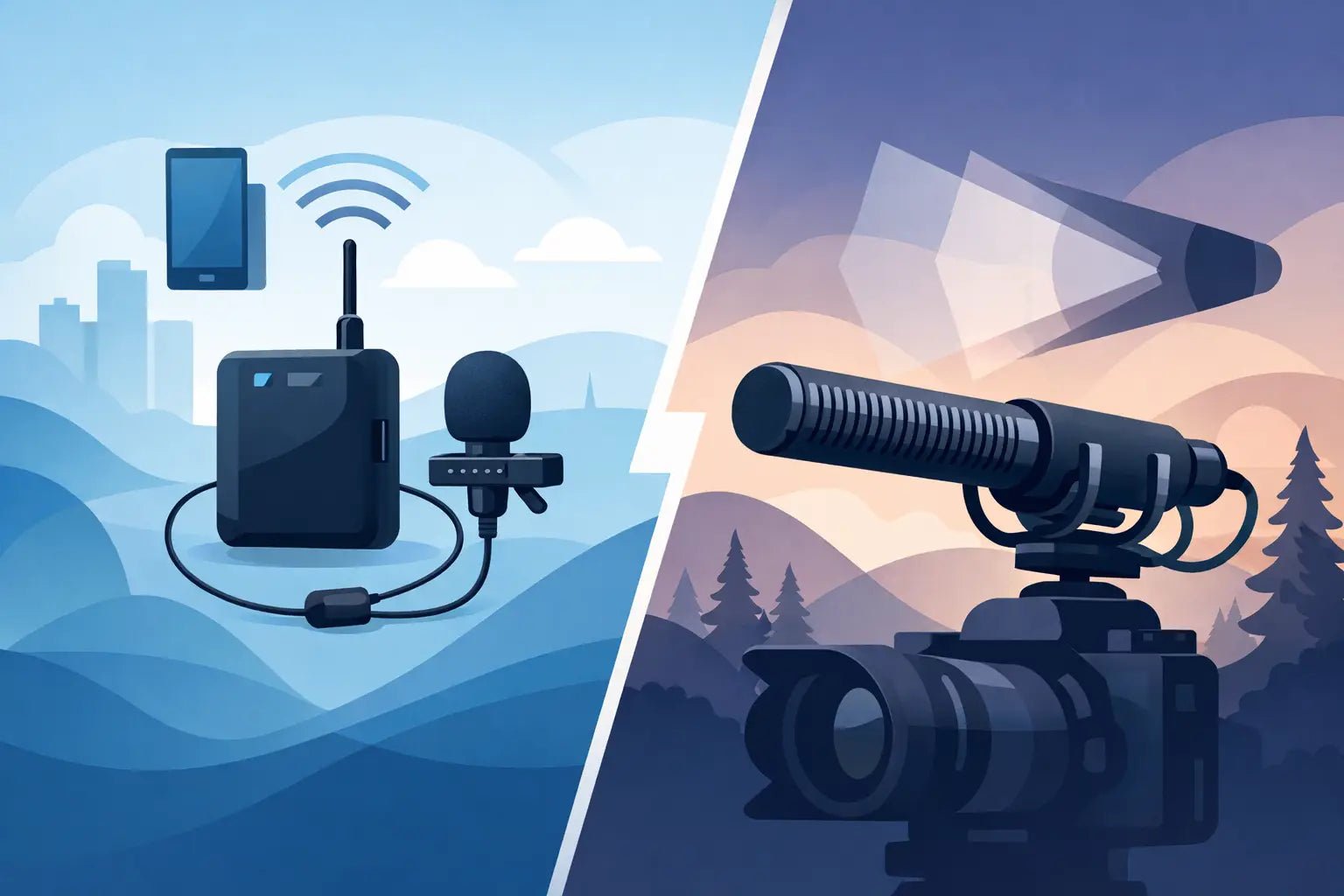
One bad audio take can make a sharp-looking video feel instantly disposable. That is why the wireless mic versus shotgun mic question matters more than most creators think. If you shoot on a phone, action camera, or compact mirrorless setup, the right mic does not just improve sound. It changes how fast you work, how polished you look, and how confident you feel hitting record.
For mobile creators, this choice usually comes down to one thing: where the mic sits in relation to your voice. A wireless mic lives close to the speaker, usually clipped to a shirt or hidden on clothing. A shotgun mic stays off-camera or mounted on-camera and captures sound from a distance, with a focused pickup pattern aimed at the subject. Both can sound great. Both can also fail hard in the wrong setup.
Wireless mic versus shotgun mic: the real difference
The simplest way to think about it is this. A wireless mic is built for consistent voice capture while you move. A shotgun mic is built for directional capture when you can keep the mic aimed well.
That difference affects everything. With a wireless system, your voice stays relatively even because the microphone remains close to your mouth. If you turn your head, walk down the street, or hold the camera farther away, your voice still comes through with more stability. That is a huge win for vlogging, tutorials, fitness content, run-and-gun interviews, and social clips where speed matters.
A shotgun mic works differently. It is designed to reject some side noise and focus on whatever it is pointed at. When the mic is boomed just out of frame and positioned correctly, the result can feel natural, open, and cinematic. But the phrase there is positioned correctly. If the mic is mounted on top of a camera several feet away from your mouth, it often captures more room tone, traffic, echo, and environmental noise than creators expect.
This is why the wrong mic can create a mismatch between your setup and your style. A creator filming solo with a phone on a tripod has very different needs than a small crew shooting a sit-down interview indoors.
When a wireless mic makes more sense
If your workflow is mobile-first, wireless usually wins on practicality. It gives you freedom to move, frame wider shots, and talk naturally without hovering near the camera. For creators making TikToks, Reels, YouTube shorts, travel videos, reaction clips, or product demos, that convenience is not a small perk. It is the workflow.
The biggest advantage is proximity. Good audio starts with getting the mic closer to the source, and a wireless mic does exactly that. It keeps your voice present even in less-than-perfect environments. Busy streets, trade show floors, gyms, parks, and event spaces are all easier to manage when the mic is attached to the talent instead of sitting on the camera.
There is also the speed factor. Wireless systems made for creators are usually quick to pair, easy to clip on, and simple to use with phones, tablets, action cameras, and creator rigs. That matters when you are recording between meetings, catching a trend in real time, or grabbing content while traveling light.
Style plays a role too. Traditional audio gear can feel bulky and production-heavy. Compact wireless systems fit better with modern creator setups because they look cleaner, pack smaller, and ask less from the user. Sound with style is not just branding. It is a real advantage when your gear has to work on camera and in motion.
Best use cases for wireless
Wireless is a strong fit for walk-and-talk videos, mobile interviews, solo vlogs, live selling, tutorials, fitness instruction, motorcycle or cycling content, and any format where the camera is not staying close to the speaker. It also makes sense when you want a polished voice without building a full audio rig.
When a shotgun mic is the better call
Shotgun mics shine when you can control placement. In a more deliberate setup, they can sound excellent without being visible in frame. That is why they are common in filmmaking, studio interviews, desktop talking-head videos, and scenes where a boom operator or fixed stand can keep the mic close above the subject.
They are also useful when you do not want to clip a mic to clothing. Maybe wardrobe matters. Maybe you are filming a dramatic scene. Maybe you want to avoid the visual footprint of a lav-style setup. In those cases, a shotgun mic can give you cleaner visuals while still delivering focused sound.
But there is a catch. Shotgun mics are often overestimated by creators using them on-camera. A lot of people assume a shotgun mic can zoom in on sound from across the room. It cannot. Directional does not mean magical. If the mic is too far away, your audio will still sound far away.
This is where expectations matter. A shotgun mic mounted on a vlogging camera can improve things over the built-in mic, but it usually will not match the direct, present vocal quality of a wireless mic attached to the speaker. If your goal is voice-first content with clear dialogue, distance is the enemy.
Wireless mic versus shotgun mic for specific creator setups
For smartphone creators, wireless tends to be the easier and smarter choice. Phones are often used farther from the speaker than people realize, especially for vertical content, cooking videos, and solo shoots. A wireless mic solves that immediately by bringing the microphone to your voice instead of asking your phone to do all the work.
For action cameras, the same logic applies. GoPro and similar cameras are built for movement, wide shots, and environments with wind or ambient noise. A wireless mic gives you more control over speech clarity, which is usually the thing viewers care about most.
For desktop creators and podcasters, it depends. If you are seated in a treated space and can mount a shotgun close above frame, it can work beautifully. If your room is reflective or your setup changes often, a wireless system may still be the easier path to consistent vocals.
For interviews, both can work. A two-person wireless setup is often best for fast production and clean speech from each subject. A shotgun can be excellent for more cinematic interviews, especially with a crew. Solo creators usually benefit more from wireless because it removes one more thing to monitor.
What about background noise, echo, and wind?
This is where people often get tripped up. No mic type is immune to a bad environment. The better question is which mic handles your environment more gracefully.
Wireless usually wins against background noise because it stays close to the mouth. That stronger voice signal gives you a better starting point. Some modern creator-focused systems also include onboard processing or voice enhancement that helps speech cut through more clearly.
Shotgun mics can reject some side noise, but they are not a cure for echo or street noise if placed too far away. In a reflective room, a shotgun can still capture a lot of the room. Outdoors, it can sound great with proper wind protection, but so can wireless. The deciding factor is usually placement, not marketing language.
The trade-off no one mentions enough
Wireless is usually better for convenience and vocal consistency. Shotgun is often better for invisible placement and a more natural, cinematic feel when used correctly. That means the choice is not really about which mic is better overall. It is about what kind of friction you want in your process.
Do you want the fastest route to clean voice capture while moving through the world? Wireless makes a lot of sense. Do you want a controlled setup with no mic visible and the ability to shape scenes more traditionally? Shotgun may be worth the extra care.
For most modern creators, especially those building for social platforms and lightweight production, convenience is not a luxury. It is part of quality. If a setup is too slow, too bulky, or too technical, you use it less. The best mic is the one that fits your actual shooting rhythm.
So which one should you buy?
If your content is voice-led, mobile, and filmed without a crew, start with a wireless mic. It gives you more usable audio in more situations, with less setup and more freedom. That is why so many creators moving between iPhone, Android, DJI, and GoPro workflows lean in this direction.
If your content is more controlled, more cinematic, or mostly shot indoors with careful framing, a shotgun mic can absolutely be the right tool. Just do not expect it to replace close mic placement when the camera moves back.
The smartest creators do not buy based on category alone. They buy for the shot, the platform, and the pace of their work. If your brand lives on quick capture, polished speech, and gear that looks as good as it performs, a compact wireless system from a creator-first brand like Wynwood Sound often fits the moment better.
Choose the mic that lets you create more often, with less compromise, and your audience will hear the difference before they ever notice the gear.